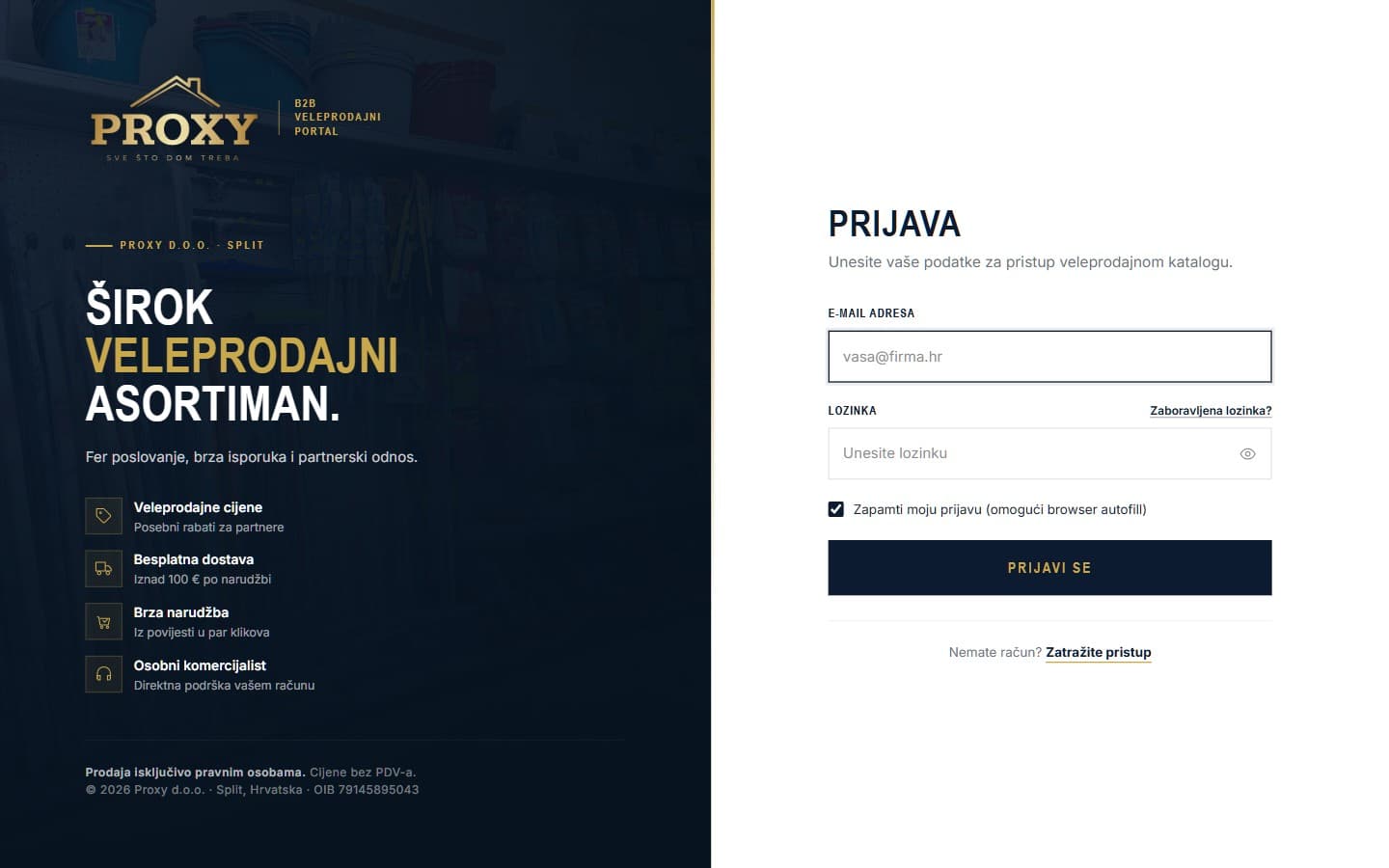
B2B wholesale portal
Your business partners place orders 24 hours a day on their own. They see their own prices, discounts and real stock levels. You stop re-typing orders into the ERP and get time for sales that actually generate revenue.
- Duration
- 2 to 5 weeks
- In production
- Proxy d.o.o., Solin
The same Monday, with the portal and without it
A wholesaler that takes orders by phone and e-mail does the same work twice every day.
- 07:30Without the portal
The weekend's orders are waiting in e-mail and WhatsApp. Someone has to retype them into the ERP before the warehouse can start.
With the portalThe weekend's orders are already in the ERP. The warehouse has its pick lists and is packing.
- 09:00Without the portal
A customer calls to ask whether an item is in stock and what his price is. The sales rep opens the ERP and reads it out.
With the portalThe customer saw it himself in the portal: his price, his discount and the stock.
- 11:00Without the portal
A retyped order has the wrong item code. The goods go out, come back, and a credit note is booked.
With the portalThe customer picked the item himself, so the order reached the ERP with the right code.
- 14:00Without the portal
The sales rep is at a customer's shop, writing the order on paper. He will enter it tomorrow.
With the portalThe sales rep places the order on the customer's behalf while still sitting with him.
- 20:00Without the portal
A shop owner remembers what he is short of. He sends a message and waits for the morning.
With the portalHe orders in the evening from the shop. In the morning his goods are on the pick list.
How many hours go into retyping orders
Enter your own numbers. We count only the entry into the ERP, without the calls, stock checks and fixing wrong codes.
That is 84 working days a year. When customers order on their own, those orders reach the ERP with nobody entering them.
The sum: orders × minutes × 21 working days a month, an 8-hour day.
Send us those two numbersWhat changes in sales after that
A new customer does not need a new person in the office
You open an account for a new customer. His prices and discounts come from the ERP, and his orders go in the same way as everyone else's.
The customer sees the whole range
On the phone a customer orders what he remembers. In a catalogue with photos and filters he also sees goods he did not know you stock.
The sales rep has time for the field
The time that went on reading out prices and retyping orders is now spent with customers, and the order is entered on the spot, on the customer's behalf.
A chain with several branches orders without mix-ups
A customer with several branches picks which one he is ordering for. Each has its own price list and delivery address, so the goods arrive where they should.
What the system does for you
- Partners order when it suits them, not during business hours
- Each customer sees their own price and their own discount, automatically from the ERP
- Stock in real time, no more "do you still have it" calls
- Sales reps can order on behalf of a customer and take their context
- Customers with multiple business units switch the active unit in one click
- All orders sync into the ERP automatically, no duplicates on retry
- Warehouse module with picking lists, packing and shipping
Who benefits the most
- Wholesalers with hundreds of business customers
- Customers with multiple business units and different price lists
- Companies that already keep stock, prices and discounts in an ERP
- Sales teams still taking orders by phone and email
- Catalogs with more than a thousand SKUs
Tech in the background
This is what runs under the hood. For the client, all that matters is that the system works.
- Safe order writes without duplicates, automatic retry when the ERP hiccups
- Logging without sensitive data, GDPR-safe
- Access limits and protection on auth endpoints
- Stable integration with Croatian ERP systems
Starts with a conversation about your ERP, customers and business rules. Ends with a production launch and a detailed check before anything goes live.
Thirty days from the first conversation to a portal through which customers order on their own
Proxy d.o.o., Solin. Wholesale of household goods and catering supplies
Specific questions about this service
Can we use our existing site?
Yes. We migrate the existing site and add the B2B portal as a layer, or start fresh, depending on what's there.
What if our ERP changes?
The connector is adaptable. It can be adjusted to a new ERP with additional development. Existing data is preserved during the transition.
How does a customer see their own price?
Prices are loaded from the ERP by customer class or group. The logic is finalized in the documentation phase, before any code is written.